
Gentle batch blending
Review a tumbling approach where breakage, fines, or changes in particle character matter.


We help manufacturers improve dry blending, reduce lumps, control particle size, screen materials, increase consistency, and solve difficult bulk solids processing challenges.
Munson equipment supports food, beverage, nutraceutical, pharmaceutical, chemical, minerals, plastics, recycling, and industrial applications where reliable mixing, gentle handling, cleanability, and repeatable production results matter.
Dry blending • De-lumping • Milling • Sifting • Screening • Size reduction • Batch mixing • Bulk solids handling
Blend a batch gently while protecting particle integrity.
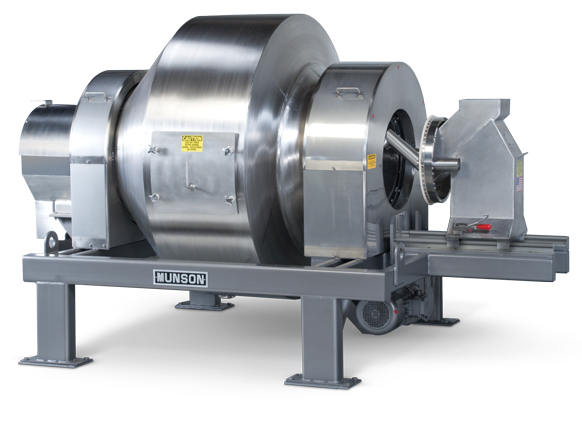
Are fragile ingredients, uneven blends, or slow cleanouts limiting production?
Munson Rotary Batch Mixers use a rotating horizontal drum with internal flights to tumble, turn, cut, and fold bulk solids. The inlet and outlet remain stationary while the drum rotates.
Typical application
Blend roasted coffee beans, tea ingredients, dry food mixes, or suitable mineral formulations.
Also known as: Tumble mixers, drum blenders, rotary batch blenders.
Review a tumbling approach where breakage, fines, or changes in particle character matter.
Stationary inlet and discharge points help coordinate loading and downstream handling.
Review internal access and the discharge sequence against your cleaning requirements.
Confirm the batch recipe, usable volume, and loading method.
The rotating drum and internal flights move ingredients through the batch.
Flights guide product toward the stationary outlet.
Coffee beans, teas, seasonings, and other suitable dry ingredients. Describe fragility, oils, and changeover requirements.
Powder blends where uniformity and cleaning matter. Agree on a sampling and acceptance method for trials.
Discuss glass, cement mixes, and abrasive ingredients alongside wear-resistant construction.
Munson shows the rotating drum, internal mixing action, and discharge arrangement. Use the overview to review how your ingredients enter, blend, and leave the machine.
See the rotary batch mixer in a coffee-blending process. The example illustrates handling fragile beans and coordinating loading and discharge; performance must be assessed for your own recipe.
Munson application example
Kicking Horse Coffee uses a Munson rotary batch mixer in its Canadian coffee operation. The published case shows how roasted beans are loaded, blended, and discharged. For a similar project, discuss bean breakage, recipe changes, batch sizes, and how the blender connects to roasting and packaging.


Photos: Munson Machinery. Read the full application story >>
Send your formulation, smallest and largest batches, bulk densities, liquid additions, current problem, and a process sketch. Describe how you will measure a successful blend.
Not necessarily. Describe the agglomerates and the particle integrity you need to preserve. An intensifier or a separate conditioning step may be appropriate, subject to the material review.
Agree on ingredient proportions, the sampling method, and the acceptable variation. Review loading, mixing, discharge, and cleaning as a complete cycle. A representative material trial can help establish the operating target.
Share the formulation and constraints, including particle damage, cleanability, available space, and budget. RTS can review the alternatives with Munson and discuss the appropriate testing route.
Final capacity, materials, finishes, drives, and options are confirmed for the selected application. Use certified drawings for installation.
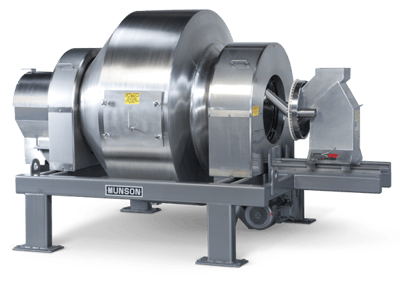
Blend a batch gently while protecting particle integrity.
Example: Blend roasted coffee beans, tea ingredients, dry food mixes, or suitable mineral formulations.
Also known as: Tumble mixers, drum blenders, rotary batch blenders.
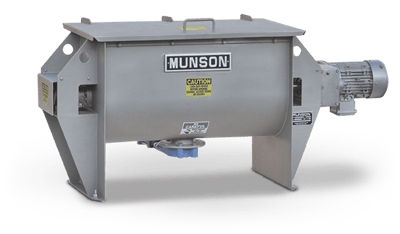
Choose the agitator around how your material moves.
Example: Blend seasonings, chemical powders, or suitable solids with liquid additions.
Also known as: Ribbon mixers, horizontal paddle mixers, trough blenders, plow mixers.
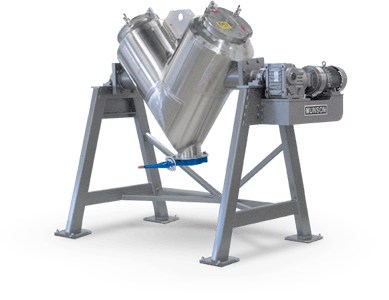
Tumble dry powders and granules in a smooth mixing vessel.
Example: Review dry pharmaceutical, nutritional, food, or industrial powder batches.
Also known as: Vee cone blenders, V blenders, V-shell tumble blenders.