
Start with controlled material delivery
The integral prefeeder supplies the belt and helps establish a consistent initial flow.


Improve Feeding Accuracy | Control Material Flow | Increase Process Reliability
We help identify and implement the right Acrison dry solids metering solution for powders, granules, flakes, pellets, ingredients, additives, and dry chemicals. From volumetric feeders and weigh feeders to bin dischargers, continuous blenders, bulk bag unloaders, dust collectors, and control systems, Acrison equipment helps manufacturers improve feeding accuracy, material handling reliability, and process control.
Get a Dry Solids Metering RecommendationModel 203 Series · Control a continuous dry-solids stream with a weighed belt and integral prefeeder.

Would belt weighing suit the material and the way it enters your process?
The Acrison Model 203 combines a variable-output prefeeder with a scale-mounted, constant-speed weigh belt. The weighing system measures the product on the belt and the controller adjusts the prefeeder output to match the selected mass-flow rate. It is a gravimetric method that measures material on a belt rather than loss of weight from a supply hopper.
Typical application
Meter a continuous ingredient stream where a suitable prefeeder can deliver the material consistently onto the belt.
Also known as: Weigh belt feeders, belt weigh feeders, gravimetric belt feeders, continuous weigh feeders.
The integral prefeeder supplies the belt and helps establish a consistent initial flow.
The weighing and control system refines delivery against the selected mass-flow setpoint.
Review the correct mechanism for the product rather than relying on the belt to solve upstream flow problems.
The selected integral prefeeder meters material onto the weigh belt.
The scale-mounted belt runs at constant speed while the weighing system senses the product load.
The controller adjusts the variable-speed prefeeder to bring the weighed output toward the selected feed rate.
Review suitable dry ingredients, including difficult-handling products, with the appropriate prefeeder and cleanout arrangement.
Compare product loading, carryback, discharge behaviour, and the required rate range with the belt arrangement.
Discuss wear, adhesion, dust, temperature, and containment. Final suitability depends on both the belt and the prefeeder.
Prefeeder application demonstration
This official Acrison demonstration shows a Model 105Z metering dried potato flakes. The 105Z is the prefeeder type shown on the 203-105Z configuration. The clip illustrates material handling; it does not show the complete weighbelt assembly or its feedback control.
Watch on Acrison’s official YouTube channel · Manufacturer video library
Review how the material loads the belt, how it releases at discharge, and what could remain on the belt after discharge. Include upstream flow control, dust enclosure, service access, cleaning, and the full required rate range in the application review.

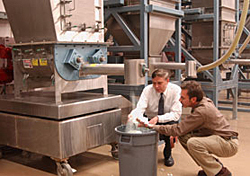
Application imagery: Acrison.
Send a material sample description, minimum and maximum feed rates, bulk-density range, particle sizes, moisture, and a process sketch. Include the required accuracy, measurement interval, upstream refill method, cleaning needs, and available space.
Review My Feeding RequirementsThe 203 measures material travelling on its belt and corrects the prefeeder output. A loss-in-weight system measures the reduction in weight of a supplied hopper and feeder over time. Compare process layout, material behaviour, refill arrangements, cleaning, and the required performance before choosing.
Acrison offers witnessed equipment demonstrations and material testing. Agree on the feed-rate range, sample collection method, test duration, and acceptance criteria so the results reflect the intended process.
Consider the hopper, metering mechanism, weighing method where applicable, refill supply, controls, discharge connection, dust management, and access for cleaning. Identify which equipment and interfaces need to be included in the quotation.
Confirm capacity, accuracy test conditions, materials, drive, controls, and construction for your actual application. Product-family ranges and example installations are not a guarantee for every material or feeder size.

Meter by volume
Meter a controlled volume of free-flowing granules or pellets.
Example: Meter plastic masterbatch pellets or another suitable free-flowing ingredient into a process.
Also known as: Volumetric screw feeders, single-auger feeders, dry ingredient dosers.

Control by loss of weight
Control ingredient mass flow using loss-in-weight measurement.
Example: Control an additive or ingredient feed in kg/h, or deliver a defined batch quantity.
Also known as: Loss-in-weight feeders, weight-loss weigh feeders, LIW feeders, gravimetric dosing systems.
Weigh a continuous belt stream
Control a continuous dry-solids stream with a weighed belt and integral prefeeder.
Example: Meter a continuous ingredient stream where a suitable prefeeder can deliver the material consistently onto the belt.
Also known as: Weigh belt feeders, belt weigh feeders, gravimetric belt feeders, continuous weigh feeders.